
Searching Barbour County Criminal Dockets
Look at the citation, complaint, or hearing notice first. It names the court. The free Magistrate Court Record Search, known as MCRSearch, handles Barbour County Magistrate Court misdemeanors, traffic cases, and felony preliminary proceedings. For Circuit Court work, turn to the West Virginia Public Access Search System, or WVPASS, which covers public Circuit cases including felonies that move past the Magistrate stage. An exact case number beats a name every time. Why? A name search can pull up to 30 MCRSearch results, so match the county, location, case type, and filing date before you open anything.
The internet is not the only door. Circuit Clerk Gerald Fogg keeps Circuit criminal files at 26 N Main Street, Suite 2, Philippi, phone 304-457-3454. Magistrate Clerk Danah Alth holds the Magistrate records at 47 Church Street, second floor, Philippi, mailed to PO Box 541, phone 304-457-3676. A specific written request works at the counter or by mail once payment and postage are settled. Call ahead to confirm which office has the file, the next court date, or whether another delivery method is allowed.
- Identify Magistrate or Circuit Court from the source paper.
- Use MCRSearch for Magistrate cases or WVPASS for Circuit cases.
- Search by exact case number, or use the party name and verify the court.
- Read charges, events, docket entries, plea, and disposition as separate fields.
- Ask the proper clerk for a missing paper or certified copy.
Barbour County Criminal Docket Codes
MCRSearch tags each filing and event with a short code. Treat them as clues, not verdicts. On a Barbour County criminal docket, MMFCF marks an observed misdemeanor complaint. And MFFCF marks a felony complaint at the Magistrate stage. An initial-appearance rights sheet shows up as MMIRS. When bond gets set, expect MBOND; when it gets posted, MBONI. No complete statewide codebook exists in the public sources. Lean on the description printed next to each code.
- MGNCH
- Notice of hearing, which may supply the next event but does not decide the case.
- MGMCT
- Motion to continue. Look for a later order and a new setting.
- MGHCC
- Hearing or event closed. This does not necessarily mean the whole case is closed.
- MMOJO
- Order, criminal judgment. Obtain the signed order for controlling terms.
Inside a Barbour County Criminal Docket
Open a Barbour County Magistrate criminal case and you may see a case ID like 19-M01M-00690. It also shows the location, case type, filing date, trial type, and status. The charge block lists every count separately. Each one carries its statute, description, plea, disposition, and disposition date. Bond, party, event, and docket-entry blocks round out the picture. Read the counts one by one. Two counts can carry different outcomes on different dates. And a bond amount is never a fine or a final judgment.
| Case number | Exact local identifier and the key for a clerk request. |
|---|---|
| Charges | Count, statute, description, plea, disposition, and date where entered. |
| Events | Date, time, room, location, judge, and reason closed. |
| Bond | Type, set or reduced amount, posted amount, status, receipt, and dates. |
| Docket entries | Filing date, code, short description, and filer. |
A docket entry is a summary of what happened, not always the paper itself. MCRSearch shows case detail but no document images. WVPASS will sell a public Circuit document image for $0.25 per page plus a card-processing charge. Even that download is not certified. For the exact sentence, condition, or release language, only the clerk's signed judgment counts.
Barbour County Criminal Transfer Trail
Felony cases often travel. A complaint filed in Barbour County Magistrate Court can move to Circuit Court once the preliminary stage wraps up, leaving two linked records instead of one tidy page. In MCRSearch, MGTCC signals a transfer to Circuit Court. MBTCC means bond transferred too. Jot down the Magistrate case number, the transfer entry, and its date. Then run a WVPASS search for the Circuit case that follows.
If the trail stops: ask the Magistrate Clerk for the transfer reference, then give that information to the Circuit Clerk. Portal silence is not proof that the prosecution ended.
How a Criminal Case Moves
Work through the Barbour County criminal docket in time order. The start usually looks like a complaint, citation, or indictment-related entry. At the first appearance you might spot a rights sheet, counsel, bond, and a hearing notice. A felony complaint then shows a preliminary hearing, a waiver, or a transfer entry. Expect motions, appearances, continuances, notices, and orders during the pretrial stretch. The plea or trial fields give way to a judgment, dismissal, deferred outcome, sentence, or other disposition. Bond, review, appeal, or transfer entries can keep arriving after the main decision.
Docket flow: Filing › Arraignment › Pretrial › Plea or Trial › Disposition › Sentencing
A motion entry is a request. It does not mean the court said yes. A hearing marked closed describes that one event, not the whole case. Line up the case header, the charge-level disposition rows, and the signed orders first. Only then decide anything. The docket indexes court acts; the judgment holds the result.
Barbour County Criminal Docket Pitfall
One trap deserves special attention. A hearing ends, gets reset, or gets replaced by another notice. A closed event can still sit in MCRSearch after that. That does not mean the Barbour County criminal case is closed. Check the header status, each count's plea and disposition, the later docket entries, and any order. Keep the roles straight. A notice sets a date, a motion asks for action, and only the later order shows what the court actually did.
When a future date seems missing or clashes with a paper notice, call the clerk. Use the court named on the case. The county publishes no official daily docket PDF and posts no refresh schedule. The latest online setting plus a direct call to the court is the sound chain.
Courts That Hold Criminal Dockets
Barbour County Magistrate Court is where most people begin. It handles misdemeanors, many traffic citations, and the preliminary stages of felony cases. MCRSearch carries its docket, and the Magistrate Clerk holds the filed papers. Felony prosecutions move to the Barbour County Circuit Court in the 23rd Judicial Circuit. A case arrives there by indictment, information, or transfer. WVPASS provides that court's public search and documents.
A municipal court can hold a city ordinance charge. That is a separate record, not a state Magistrate case. Family, juvenile, and protected proceedings follow their own access rules too. Match whatever court and location appear on a result back to the source paper. Rely on it only after that check. One more caution: the County Clerk keeps probate and County Commission records. Those are not the Barbour County criminal docket.
Missing Barbour Criminal Docket Documents
MCRSearch shows case detail on purpose, not document images. Need a complaint, bond paper, rights sheet, order, or judgment? Write down the case number and the exact docket entry, then call the Magistrate Clerk. WVPASS displays public Circuit images, but only for cases filed from July 1, 1999 onward. Older papers, undigitized filings, and protected material take a clerk inquiry.
Ask for a specific item rather than the whole file. Give the court, the case number, and any known filing or disposition date. Include a description of the document and whether you want plain or certified copies. Add your return address and contact details. Phone staff can confirm custody and fees, though they will not read a full file aloud. They may arrange supervised inspection or copies instead. The clerk posts no Barbour-specific online certified-copy form and guarantees no turnaround.
Barbour County Criminal Docket Numbers
Official 2024 court statistics put the Circuit criminal workload in perspective. Barbour County reported 83 felony filings that year. It also reported 4 misdemeanor filings and 25 matters in an other-criminal category. That totals 112 Circuit criminal filings. The numbers count filings only. They say nothing about pending cases, convictions, or hearings held. Magistrate complaints and preliminary stages fall under separate reporting.
Those figures show why court identification matters. A Magistrate case is often the first public record, while a later Circuit filing is counted and searched on its own. Track the case numbers and transfer entries instead of using the annual total to guess where any single case stands.
Sealed Dockets and Public Access
West Virginia statutes and trial-court rules govern public criminal dockets, yet access has limits. WVPASS bars sealed, confidential, and juvenile material, and grand-jury records can be restricted as well. A missing result may mean an access rule, an older file, or a record sitting in another system. It never proves that no proceeding exists. Ask the clerk about your options. A public header, a redacted copy, or supervised inspection may be legally available.
Docket events often trace back to procedure. The official Magistrate criminal procedure rules show how pleas, dismissals, and missed appearances generate entries on a Barbour County criminal docket. For what actually happened in a case, the live docket and the signed order still control.
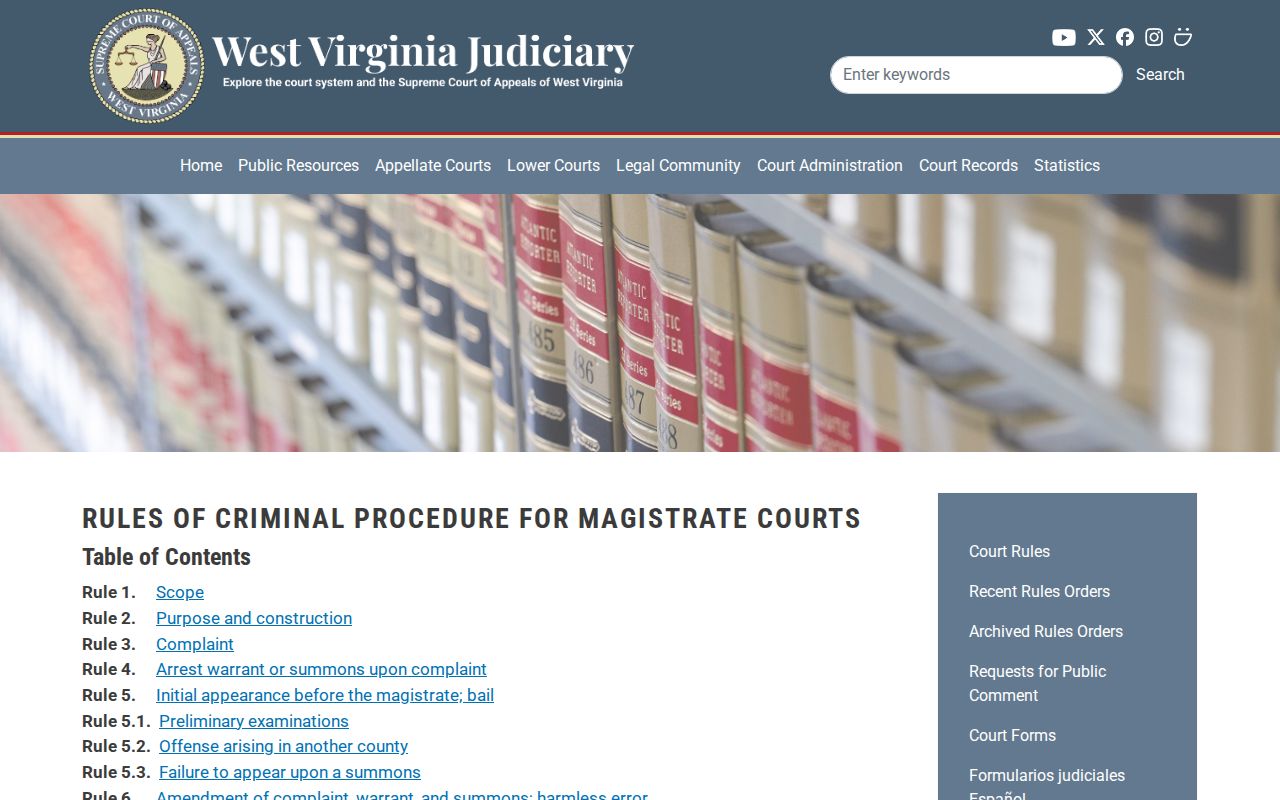
Read the rule text to understand the process. Then confirm the actual entry with the Barbour Magistrate Clerk or Circuit Clerk.
Key Rules:
West Virginia Code §51-4-2 provides court-record inspection and copy authority, read with court rules.
West Virginia Code §29B-1-3 sets a public-record request and five-business-day response framework, subject to exceptions.
West Virginia Code §49-5-101 protects juvenile records from ordinary public access.
West Virginia Trial Court Rules 15A.23 through 15A.26 cover sealing, private identifiers, redaction, and electronic access. If access is denied, ask for the legal basis in writing. Never copy birth dates or other private identifiers from a public result.